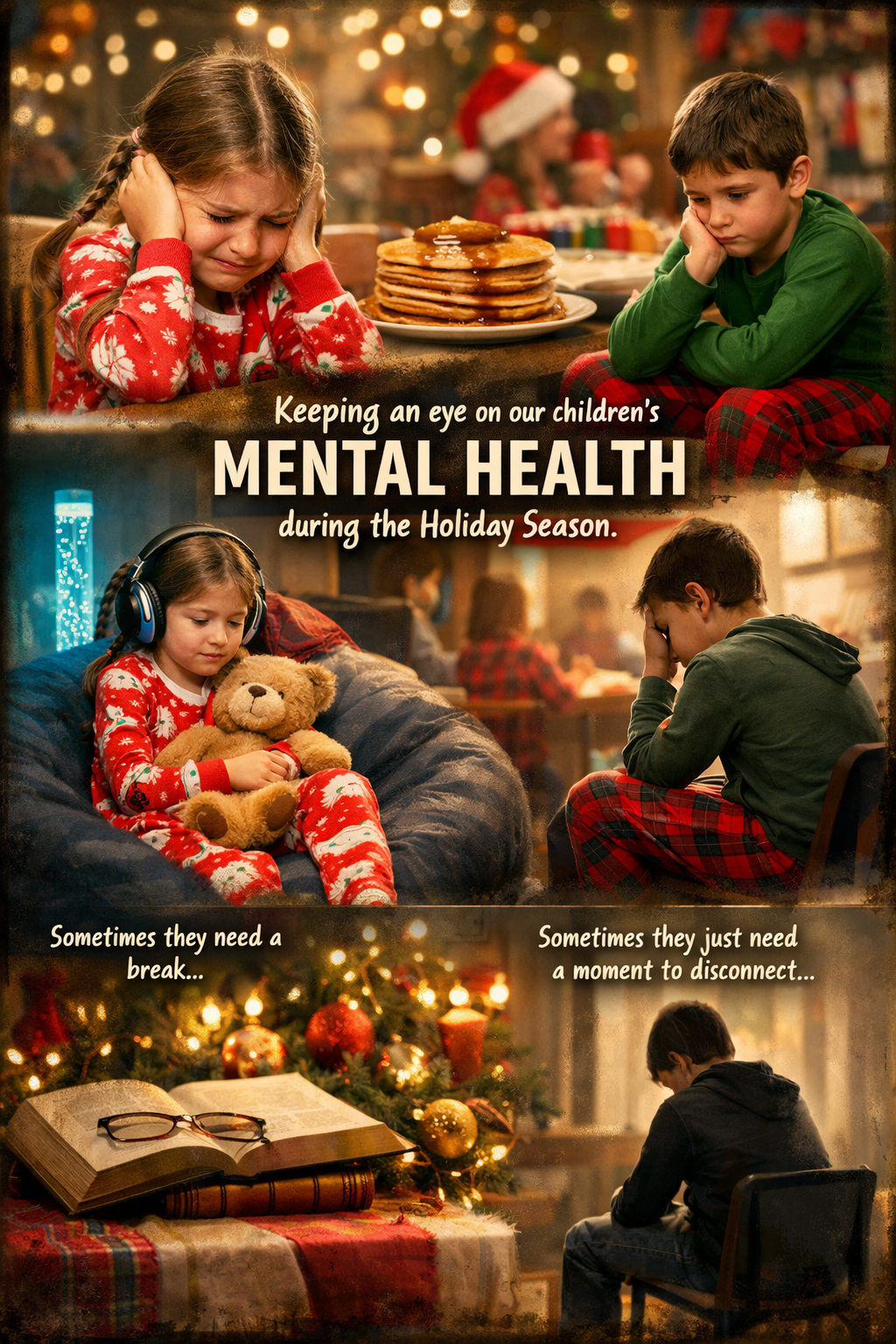
Last night, after a full day of tutoring and church, we headed straight into our church’s Pajamas and Pancakes Christmas party. Wednesdays are already our busiest day of the week—tutoring earlier in the day, church right after, and very little margin for rest in between. On paper, it sounds festive and joyful. And it was—but it was also a reminder of something important that often gets overlooked during the holiday season.
During the party, my daughter Abigail became overstimulated. The noise, the excitement, the change in routine—it all caught up to her. What started as excitement quickly turned into overwhelm. She needed to be pulled out of the activity and taken to what our church calls the “quiet room,” a space designed for sensory kids who need a break from the stimulation. It was a gift that the space existed, but it was also a clear signal that her nervous system had reached its limit.
My son Malachi had a different response. He didn’t want to participate at all. He was completely checked out. After a long day, he had nothing left to give emotionally or mentally. While it might be easy to interpret that as disinterest or attitude, it was really exhaustion—plain and simple.
Moments like these are powerful reminders that during the holiday season, our children’s schedules often become completely out of whack. Their routines shift, expectations increase, and their calendars fill up quickly. As parents, we often feel like we’re doing the right thing by including them in all the festivities—church events, parties, gatherings, programs—because we want them to experience joy, community, and tradition. And those things do matter.
But sometimes, even with the best intentions, our children are quietly struggling to keep up.
Children—especially those with sensory sensitivities, learning differences, anxiety, or neurodivergent needs—experience the holidays differently. What feels exciting to us can feel overwhelming to them. Loud rooms, crowded spaces, sugary foods, late nights, and constant transitions can dysregulate their bodies and minds faster than we realize.
Mental health during the holidays is not just an adult issue. Our kids feel it too.
We need to stay attuned to the subtle signals: the shutdowns, the meltdowns, the refusal to participate, the sudden mood shifts. These are not signs of bad behavior. They are communication. They are our children telling us they need a pause, a reset, or simply some quiet.
Sometimes the most loving thing we can do is step away from the event—even when it’s fun, even when it’s well-intended—and give our children permission to rest. Calm down time is not a failure. It’s regulation. It’s care. It’s protection.
The holidays do not have to be packed full to be meaningful. They do not have to be loud to be joyful. And they do not have to include every event to be remembered fondly.
As parents, our job is not to create perfect holiday memories—it’s to safeguard our children’s well-being while they grow through them. That means slowing down when needed, honoring boundaries, and recognizing that sometimes the quiet room, the early exit, or the choice to skip an activity altogether is exactly what our child needs.
Let’s keep an eye on our children’s mental health this season. Let’s give them space to breathe. And let’s remember that calm, connection, and emotional safety are just as important as pancakes, pajamas, and holiday cheer.
 Control Chaos Daily Grind
Leave a comment