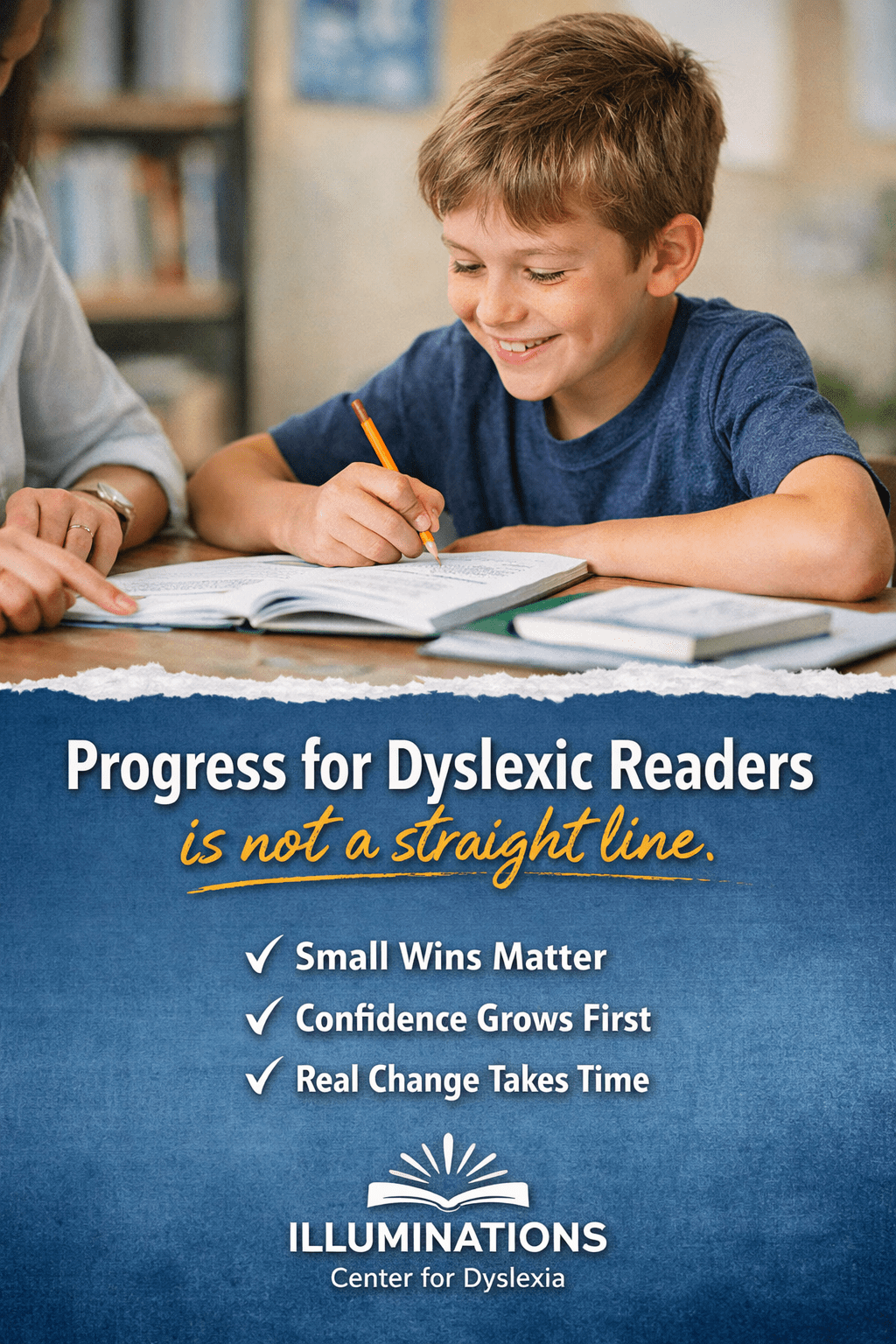
If you’re raising or teaching a child with dyslexia, you’ve probably asked this question:
“Is this working?”
Because progress doesn’t always look the way we expect it to.
We are conditioned to believe growth is linear.
A steady climb.
A straight line from struggling… to fluent… to confident.
But dyslexic readers rarely grow in straight lines.
And that doesn’t mean it isn’t working.
Why Progress Is Often Uneven (And Why That’s Normal)
Dyslexia is neurological. It affects how the brain processes language, stores sound-symbol connections, and retrieves words automatically. When we intervene, we are not just teaching reading—we are strengthening and reorganizing neural pathways.
And rewiring takes time.
You might see:
A huge breakthrough one week A “backslide” the next New skills mastered in isolation but not yet in connected text Fluency improving before spelling catches up Confidence rising before accuracy stabilizes
This is not regression.
It is consolidation.
The brain learns in layers. Structured literacy builds foundations first—phonemic awareness, decoding, morphology, and automaticity. Sometimes the visible payoff comes later.
The growth is happening beneath the surface.
Celebrating Gains Beyond Reading Level Scores
Reading levels are a snapshot.
They are not the full story.
Here are progress markers that matter just as much—sometimes more:
Your child attempts unfamiliar words instead of shutting down They self-correct without prompting Homework tears decrease They finish a book they once would have abandoned They explain word patterns or rules they’ve learned They volunteer to read aloud
Those are neurological wins.
Those are emotional wins.
Sometimes intervention is working long before the testing catches up.
Confidence often improves before scores do.
And confidence is fuel.
Signs Tutoring Is Working (Even When Scores Lag)
Parents often expect immediate jumps in standardized measures. But evidence-based intervention builds skill systematically.
Indicators that growth is happening include:
Increased decoding accuracy in controlled text Faster sound retrieval Stronger blending without heavy prompting Improved spelling pattern recall Reduced avoidance behaviors Greater reading stamina
If your child used to read for 3 minutes before shutting down and now reads for 10—that is progress.
If they used to guess and now attempt to decode—that is progress.
If they no longer say, “I’m dumb,” after every mistake—that is life-changing progress.
Test scores measure performance on a specific day.
Intervention changes the brain over time.
For Parents of 3rd Graders Facing High-Stakes Testing
If you have a 3rd grader staring down a promotion test, I see you.
High-stakes testing adds pressure to an already fragile situation. When retention is tied to a single assessment, every practice passage can feel heavy. Every missed question can feel like a verdict.
But here is what is important to remember:
A standardized test measures performance under pressure on one specific day.
It does not measure intelligence.
It does not measure potential.
It does not measure the depth of the work your child has done all year.
If your child is receiving structured literacy intervention, you are building long-term proficiency—not just short-term test survival.
The goal is not just to pass 3rd grade.
The goal is to build a reader for life.
And sometimes the most important progress happening right now won’t show up in a single testing window—but it will show up in 5th grade, in middle school, and beyond.
A Strong Call to Action
If you are unsure whether your child is making the progress they should…
If you feel stuck watching scores that don’t reflect the effort being poured in…
If your child is in 3rd grade and you are feeling the weight of high-stakes decisions…
Do not wait.
At Illuminations Center for Dyslexia, we use structured, evidence-based literacy intervention designed specifically for students with dyslexia and language-based learning differences. Our goal is not quick fixes. Our goal is durable reading growth.
We walk alongside families.
We measure real skill development.
We celebrate the invisible wins.
And we build readers from the inside out.
If your child needs targeted intervention—not just support, not just accommodations, but true remediation—reach out.
Early action changes trajectories.
And it is never too late to start building the right foundation.
 Control Chaos Daily Grind
Leave a comment